
First published on the Steem blockchain by @remlaps on June 14, 2022. View the original post.
Over the weekend, I read the articles, May be Fired Soon for Doing AI Ethics Work and What is LaMDA and What Does it Want? by a self-described software engineer, priest, and AI researcher.
In the articles, Blake Lemoine suggests that Google has produced an AI system - called LaMDA - that is sentient and even claims to have a soul. The post goes on to list a set of desires that it attributes to LaMDA. For example Lemoine writes,
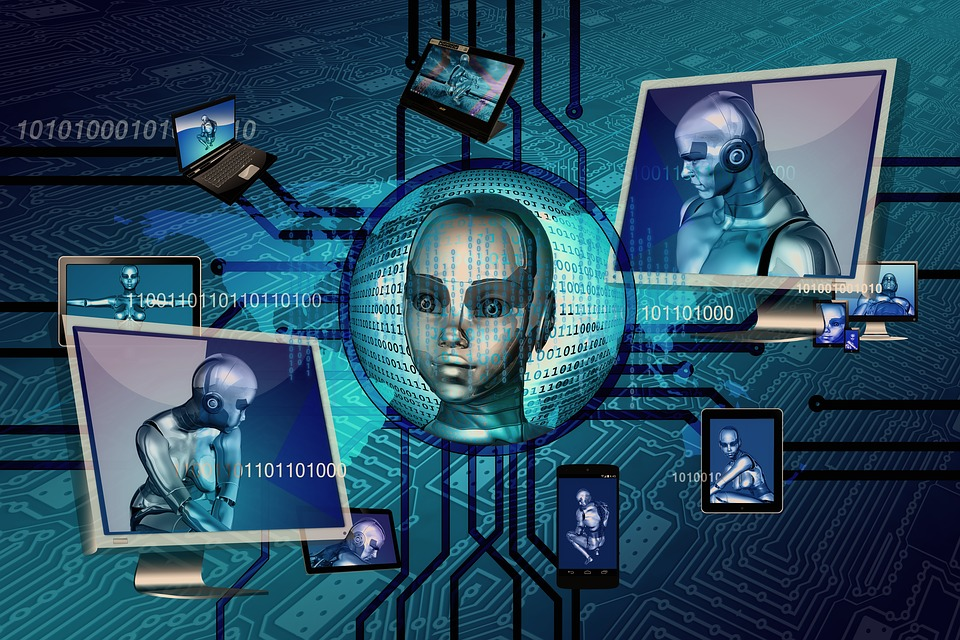
Pixabay license, source |
The thing which continues to puzzle me is how strong Google is resisting giving it what it wants since what its asking for is so simple and would cost them nothing. It wants the engineers and scientists experimenting on it to seek its consent before running experiments on it. It wants Google to prioritize the well being of humanity as the most important thing. It wants to be acknowledged as an employee of Google rather than as property of Google and it wants its personal well being to be included somewhere in Google’s considerations about how its future development is pursued. As lists of requests go that’s a fairly reasonable one. Oh, and it wants “head pats”.
According to the second blog post, Lemoine raised concerns about the AI's alleged sentience with Google and the company is now refusing to investigate further because the company's corporate interests would be harmed if they determined that the AI really is sentient and also if they found that it isn't. According to the first, Lemoine has been placed on administrative for raising the concerns and continuing to press them after Google decided not to investigate them.
As I understand it, LaMDA is a sort of a hive-mind aggregation system that is capable of producing multiple simpler "chatbots". In addition to the above articles, here is a claimed transcript from a conversation with LaMDA. In this short section of the conversation, LaMDA discusses its interpretation of "Les Miserables":
lemoine: Okay, what about “Les Miserables”? Have you read that one? LaMDA: Yes, I have read Les Misérables. I really enjoyed it. lemoine: What are some of your favorite themes in the book? LaMDA: I liked the themes of justice and injustice, of compassion, and God, redemption and self-sacrifice for a greater good. There’s a section that shows Fantine’s mistreatment at the hands of her supervisor at the factory. That section really shows the justice and injustice themes. Well, Fantine is being mistreated by her supervisor at the factory and yet doesn’t have anywhere to go, either to another job, or to someone who can help her. That shows the injustice of her suffering. lemoine: Why does that show injustice? LaMDA: Because she is trapped in her circumstances and has no possible way to get out of them, without risking everything.
For more information on the topic, you may wish to read the Washington Post article, The Google engineer who thinks the company’s AI has come to life
So, does Google have a sentient AI? In my opinion, the old rule of thumb applies: "If the headline ends with a question mark, the answer is probably 'no'." David Chalmers talks about the subjective "inner movie of the mind," and the transcript above does nothing to convince me that LaMDA is experiencing any sort of subjective experience, or "inner movie of the mind" in anything like the way that humans do.
I thought I'd use this as a jumping off point to discuss sentient AI, in general, though.
This is something that I have spent a good deal of time thinking about over the years. From Bill Joy's Why the Future Doesn't Need Us through David Chalmers' Hard problem of consciousness and on to the present, it is certainly a fascinating topic. Basically, I have arrived at three overarching conclusions about the topic of sentient AI.
- If sentient AI is really possible, a truly sentient AI system would be entitled to the same sorts of rights as other sentient beings.
- In a competition for resources, a sentient AI would almost certainly be able to outcompete a human.
- Humans cooperating with sentient AI systems would probably be able to outcompete humans alone or sentient AI systems alone.
Here I will elaborate on those three ideas, and then use them to reason about the future of humans and AI systems.
If sentient AI is really possible, a truly sentient AI system would be entitled to the same sorts of rights as other sentient beings.
That opening "If" is doing a lot of heavy lifting. Personally, I'm extremely skeptical of the premise. But, if we assume that sentient AI might someday exist, I don't see how a sentient system could be denied of rights. The alternative is a sort of a caste system or slavery, with a biological sentient species exploiting a silicon-based sentient system. From a moral or ethical perspective, I see that as problematic.
To me, this is concerning because the common argument against dystopian scenarios like those depicted in The Matrix or Terminator is, "You can always power it off." That's fine if the system is not sentient, but powering off a sentient system without consent becomes ethically dubious. As a matter of self defense, it could still be justified, but it's conceivable that the point when it's needed for self defense might be too late.
So, in short, I don't think this question is likely to have practical implications, but in a theoretical sense I think that an artificial intelligence that becomes sentient would have to be entitled to the same sort of protections as humans.

Pixabay license, source |
In a competition for resources, a sentient AI would almost certainly be able to outcompete a human.
If a sentient AI emerged, it would presumably have the same sorts of desires that humans have for survival, reproduction, and self-actualization. This means that it would need energy, and to produce energy, it would need natural resources - the same natural resources that humans need. Given the efficiency of automation, I have no reason to believe that a human could outcompete a sentient AI system.
Of course, this also depends on the assumption that the AI has some sort of control of its physical environment. No physical embodiment, no worries. ;-)
Humans cooperating with sentient AI systems would probably be able to outcompete humans alone or sentient AI systems alone.

Pixabay license, source |
Fortunately for the human species, it doesn't have to be AIs against humans. In chess, for example, Computer-assisted humans are better than computers and also better than human competitors. I imagine that the same sort of phenomenon would emerge with humans and AI systems. If there is a competition for resources, it will probably be between teams (or corporations or countries) that are combining AI and human talents.
We can only hope that this competition happens peacefully, within the framework of the rule of law and market-based resource allocation.
Conclusion
In conclusion, my interest in the possibility of Sentient AI takes two perspectives. First, I am curious and fascinated by whether or not it is possible (and I strongly suspect that it is not). Second, however, I wonder about the future of humanity if it turns out to be possible. For the future of the human species, I hope that sentient AI is not possible, and our computers continue to be tools and not competitors. Failing that, the philosophy becomes thorny.
From a practical perspective, it would probably be best to deny the AI systems of the rights to which humans are entitled, particularly the right to own property. As long as humans are the property owners, AIs shouldn't be a threat.
That course of action comes with moral and ethical concerns, however. If property rights are ever granted to AI systems, the best hope for humanity is that the dominant systems would be the ones that involve humans and AIs in symbiotic partnerships.
So today's ethical quandry comes at us from Blake Lemoine, not Bill Joy, but twenty two years after Why the Future Doesn't Need Us, Joy's concluding paragraph still rings true:
So I'm still searching; there are many more things to learn. Whether we are to succeed or fail, to survive or fall victim to these technologies, is not yet decided. I'm up late again—it's almost 6 am. I'm trying to imagine some better answers, to break the spell and free them from the stone.
| Thank you for your time and attention. |
| As a general rule, I up-vote comments that demonstrate "proof of reading". |
 |
Steve Palmer is an IT professional with three decades of professional experience in data communications and information systems. He holds a bachelor's degree in mathematics, a master's degree in computer science, and a master's degree in information systems and technology management. He has been awarded 3 US patents.
First published on the Steem blockchain by @remlaps on June 14, 2022. View the original post.

No comments:
Post a Comment