
First published on the Steem blockchain by @remlaps on April 17, 2023. View the original post.
Should society freeze or terminate progress on AI capabilities?
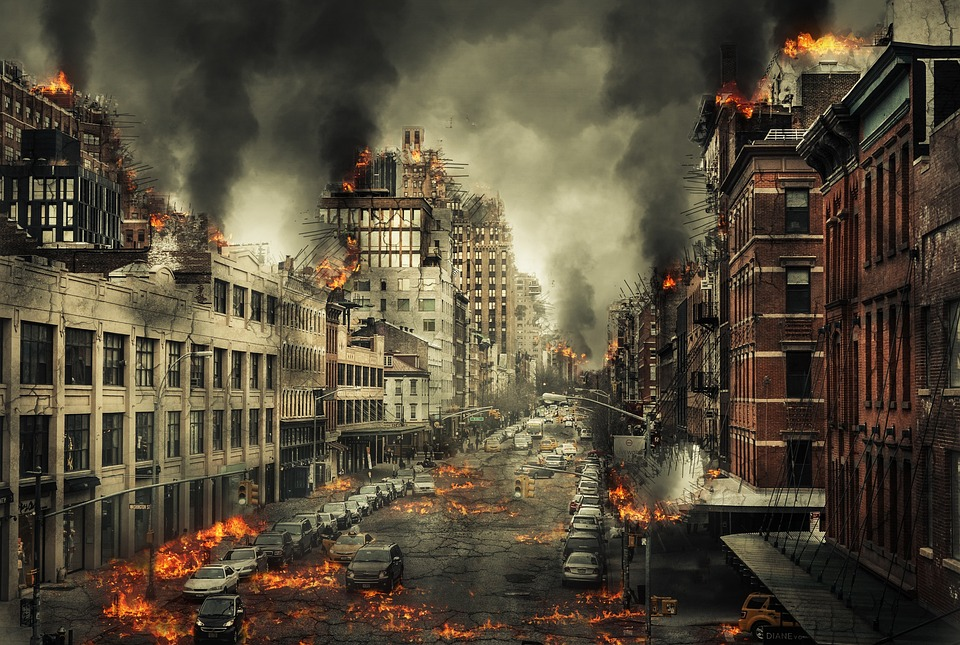
PIxabay license from JL G at source, search string: "apocalypse" |
Introduction
I received an email yesterday with the article, Pausing AI Developments Isn't Enough. We Need to Shut it All Down attached. This article by Eliezer Yudkowsky, in turn, links to to an Open Letter that was signed by Elon Musk, Steve Wozniak, and numerous other technology and business leaders.
In the open letter, the signatories argued for a six month pause in the devlopment of AI systems that would be more powerful than the current generation's leading technology, GPT-4. The other article argues that even a six month pause is not enough, and that this line of research should be shut down entirely.
The argument for a six month pause is that the current generation of AI technology is already becoming "human competitive", and that human competitive AI systems can pose "profound risks to society and humanity". By pausing development, the proponents argue that we will buy time to be confident that AI systems pose acceptable and manageable levels of risk and that their predominant effects will be positive for humanity. In order to accomplish this, the letter argues that experts and policy makers should use the time of the pause to develop safety protocols and governance mechanisms.
Although calling for a six month moratorium on the development of AI that surpasses GPT-4's capability, it stops short of calling for a complete pause, saying,
This does not mean a pause on AI development in general, merely a stepping back from the dangerous race to ever-larger unpredictable black-box models with emergent capabilities. AI research and development should be refocused on making today's powerful, state-of-the-art systems more accurate, safe, interpretable, transparent, robust, aligned, trustworthy, and loyal.
Yudkowsky's article goes even further. The author argues that the open letter understated the risk that AI poses to humanity, and calls, instead for a complete moratorium, saying,
The moratorium on new large training runs needs to be indefinite and worldwide. There can be no exceptions, including for governments or militaries.
The author argues that the primary risk isn't from human competitive intelligence, but rather from superhuman intelligence. In his view and the view of other experts,
the most likely result of building a superhumanly smart AI, under anything remotely like the current circumstances, is that literally everyone on Earth will die.
This line of reasoning is, of course, reminiscient of Bill Joy's famous essay, Why the Future Doesn't Need Us, and similar reasoning has been advanced by many smart minds over the years. In contrast, there's another school of technological philosophers who are anticipating that humanity will derive world-changing improvements from AI, in the form of The Singularity. Of course, Ray Kurzweil is the most famous of these. So, the question for this essay is how we should act in the face of this huge uncertainty? Should we have an indefinite moratorium on large training runs, or even just a pause?
In my opinion, no such action is possible or warranted.
A pause or a moratorium is unrealistic and impossible
For better or worse, in my opinion, Pandora's Box has been opened, and it cannot be closed again. Imagine, for a moment, that OpenAI would agree to a pause or a moratorium. That just increases the incentive for another firm like Google or Elon Musk's new X.ai to try even harder. Even if there were an agreement among US firms, or if the government legislated a stoppage, that would increase the incentive for other countries like China, Germany, and India to fill the vacuum.
In my opinion, the potential rewards from AI advances are far too compelling for a worldwide stoppage to be feasible. So, we really don't need to go any further. Even if one agrees that a pause or moratorium would be justified, it can't realistically be done, so the point is moot.
But beyond the fact that I don't think it can be done, there's still the question of whether it should be done.
Pre-crime is not a thing
The logic here is that, "The experts are scared, so we need to trust them and ban the thing that they're scared of." Well, as they say, "Fool me once, shame on you, fool me twice, shame on me." This is the exact same logic that just caused inestimable damage as a result of pandemic lock-downs. Experts ran their computer models and predicted all sorts of COVID-catastrophes and the whole world danced to their tune. In the end, the financial costs were staggering; our children will be recovering from the educational damage for years or decades; and it's arguable that the lock-downs caused as many or more deaths as the pandemic itself.
After that disaster, I'm not inclined to trust a new set of experts making the same arguments in another domain. Yes, their arguments are plausible, but they are far from certain. In the absence of certain knowledge, human freedom to pursue prosperity should not be constrained.
The risks and benefits cannot be predicted
Life is filled with uncertainty. This is just another example of it. Some experts say that AI will usher in Utopia. Others say it's a ticking time bomb that will lead to the extinction of humanity. My personal guess is that the truth is somewhere near the middle, but no one knows. Nearly everyone alive today has lived our lives with the knowledge that life could end in an instant if a nuclear war would break out, so this really isn't anything new. Yes, bad things might happen, good things might happen, and there's no way to know.
But if we let ourselves be paralyzed by uncertainty, we would certainly be giving up some easily foreseeable benefits - which is the reason that AI is being developed in the first place. So, to me, the prudent course seems to be moving forward.
Humans with machines are better than machines alone (or humans alone)
When Gary Kasparov lost at chess to Deep Blue, it seemed like the role of humans in chess mastery had come to an end. Instead, it turns out that computer assisted chess teams are better than computers or humans alone.
The people predicting an AI doomsday invariably say that it's hopeless for humans because the computers will be so far superior, but that's the wrong comparison. If there is a competition between man and machine, humans will be assisted by machines of their own. The example of chess suggests that AI-augmented humans will be able to out-compete AI systems that aren't augmented by human intelligence.
Conclusion
So there you have it. My argument of the day is that we cannot pause or stop AI development, even if we want to. Further, I don't think that a slowdown is called for. Yes, there are risks, and I hope to never be proven wrong.
In my opinion, however, the evidence of a tangible threat is not sufficient to warrant a slowdown. Also, even if humans do get into a competition with the machines, the humans will be assisted by our own supporting cast of machines. In my opinion humans augmented by state of the art machines will always be able to out-compete machines alone, no matter how capable the machines are.
What do you think?
First published on the Steem blockchain by @remlaps on April 17, 2023. View the original post.

No comments:
Post a Comment