Steem Promoted Posts - Proof of Concept

🚀 Promoted on Steem loading…
Fetching promoted posts…
Showing posts with label History. Show all posts

Sunday, July 19, 2026

Chester County Notables: Samuel Barber, Bayard T. Rustin, and N. C. Wyeth - A random glance at history

First published on the Steem blockchain by @remlaps on September 04, 2019. View the original post.


This post looks at some notable figures from history that I've had the opportunity to learn about in recent years, all of whom had connections to Chester County, Pennsylvania. Samuel Barber was a renowned American composer in the 20th century, Bayard T. Rustin was a civil rights leader who collaborated with Martin Luther King, Jr. and other civil rights activists of the time, and N. C. Wyeth was a widely known American artist.

Introduction
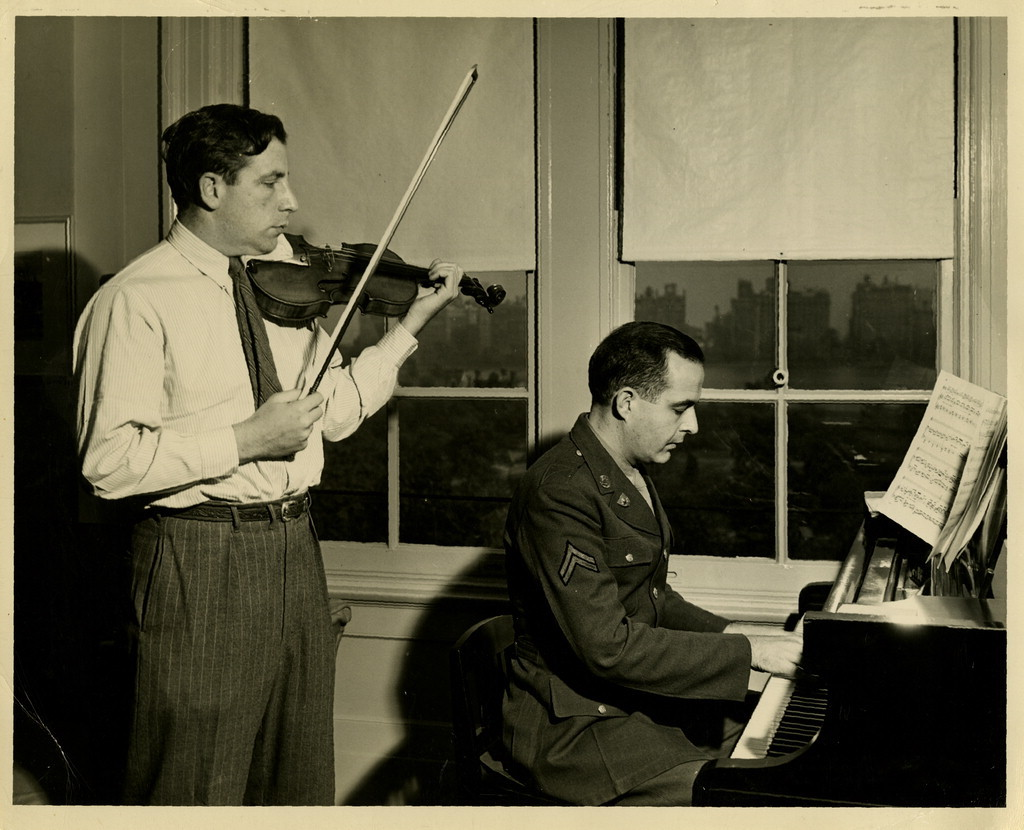
image.png
Roman Totenberg (violin) and Samuel Barber (piano), public domain photo from the US Library of Congress

Here in the introduction, I'll tell you how I happened to learn about these three noteworthy people, and in the following sections, I'll tell you some of what I've learned about their lives, and why they're noteworthy outside of our community.

The reason that I first heard of Samuel Barber is that he was a West Chester native, and, at the age of 12, he was the organist in the church that my family now attends. The first time I remember hearing his name is when it was announced at a 100 year anniversary ceremony for the church organ, and one of the pieces that was played had been composed by him, and donated to the church.

After that, when @cmp2020 went into the high school marching band, we learned that - at the age of 15 - Barber also composed the Alma Mater that is in use by all three of the high schools in the West Chester Area School District. @cmp2020 did an analysis of it last year, on Steem. It's here - Analysis of Rustin High School's Alma Mater (Composed by Our Very Own Samuel Barber), and when we visited West Chester University of PA's school of music, there was a huge mural on the wall with Barber's picture.

Moving on to Bayard T. Rustin. When we moved into this area, there were only 2 high schools in the school district. Some time around 2001 or 2002, I started hearing about plans to build a third, colloquially known as "the New School", because at the time, no one knew what it would be called. This would be the school that @cmp2020 would attend when he reached high school. Eventually, however, I learned that the school opened in 2006, having been named after Bayard T. Rustin, but I still had no idea who he was. I never thought much about it until some years later, when I read the article, The Civil Rights Movement's Unsung Hero, and I thought, "Wait. Can this be the same guy?" So then, my curiosity was piqued. It turns out that like Barber, Rustin was also a West Chester native.

Finally, we come to N. C. Wyeth. Unlike the other two, Wyeth was not born locally, but he moved to Wilmington, DE, for art school, and wound up living in the nearby Chadd's Ford area. The reason I learned about Wyeth, as you may have seen, is that @cmp2020 wrote a composition for a Young Composer's Workshop at the Brandywine River Museum of Art that was inspired by Wyeth's illustrations on display in the museum and from the book, The Boy's King Arthur. If you haven't listened to the composition, you really should (and I'm not saying that just 'cause I'm his dad):

https://youtu.be/sIizMHiRN8c

So that's how I heard of these folks. Now, let's move on to what I've learned about them...

Thursday, July 9, 2026

What does a college visit have to do with Beethoven and Mozart? - A random glance at history

First published on the Steem blockchain by @remlaps on March 18, 2019. View the original post.


On Friday, @cmp2020 and I went for his first "official" college visit at Eastern University in St. Davids, PA. We had a fun time touring the campus, monitoring a musicianship class, and meeting with admissions and music department personnel. The day also had a surprising tie-in to classical music history.

image.png

The iconic waterwheel at Eastern University
Public domain photo, circa 1913. Source

Aside from a chance comment by the admissions counsellor, there would have been nothing blogworthy about our college visit to Eastern University the other day. The day began in the admissions office, we toured the campus and had lunch in the campus cafeteria with a student tour-guide (Thanks, Collin!), then monitored a musicianship class and returned to the admissions office. Of course, all of that was interesting to a prospective student and his father, but nothing that would qualify for a blog post.

Sunday, June 21, 2026

You take the high road and I'll take the low - a short trip through musical history

First published on the Steem blockchain by @remlaps on October 07, 2024. View the original post.


When I was a kid, maybe 4 or 5 years old, there was a song that my grandfather would sing to me while I was sitting on his knee. By the time I was in my twenties, after my grandfather had passed away, all I could remember of the song was a line or two of the chorus:

You take the high road and I'll take the low road, and I'll be in Scotland before you.

Pixabay license from BuyCustomThings

Although I remembered him singing it, I had no idea what song that chorus was from for another decade or two. Then, maybe fifteen or twenty years ago, it occurred to me to use Internet magic to find the song, and I finally learned what you probably already know... The song was, The Bonnie Banks o' Loch Lomond. According to Justapedia, the song is:

"a Jacobite adaptation of an eighteenth-century erotic song, with the lover dying for his king, and taking only the 'low road' of death back to Scotland."

Having tracked it down, every once in a while, I amuse myself by listening to different renditions of the song on YouTube.

Thursday, March 26, 2020

Curating the Internet: Science and technology digest for March 26, 2020

MIT researchers submit a $100 open source ventilator for FDA approval; Chinese company offers facial recognition for people wearing masks; A new AI system approaches 100% accuracy on cancer diagnoses; A Cold-War era submarine wreck is located off the coast of Oahu, Hawaii; and a Steem post argues that surveillance may be useful for COVID-19 in the short term, but it poses long term risks


Thursday, March 19, 2020

Curating the Internet: Science and technology digest for March 19, 2020

Ultrasonic attack can break into cell phones through a solid surface; Monkeys develop immunity to SARS-CoV-2 after first infection; Hiker finds two bombs from 1935 in a Hawaiian volcano; Commentary arguing that once a medical treatment comes into common practice, it persists long after it's found to be useless, or even harmful; and a Steem essay describing a dive to the USS Oriskany aka The Great Carrier Reef


Sunday, March 15, 2020

Curating the Internet: Science and technology digest for March 15, 2020

Previously unseen footage of a Thylacine or Tasmanian Tiger; IEEE Spectrum's weekly selection of awesome robot videos; Microsoft announces the end of the line for the Visual Basic programming language; Researchers adapt flu prediction methods to the novel coronavirus; and a Steem essay describing the race to blanket the Earth in satellite-based Internet coverage


Wednesday, March 4, 2020

Curating the Internet: Science and technology digest for March 4, 2020

Honeywell claims quantum breakthrough that's twice as powerful as IBM and Google offerings; A satirical browser extension responds to the coronavirus by adding medical masks to images that contain faces; British historians find a secret door in Parliament's House of Commons; Twitter gives blue check mark to fake politician invented by high school student; and a Steem essay discusses incision and drainage as a treatment for subcutaneous abscess


Friday, February 28, 2020

Curating the Internet: Science and technology digest for February 28, 2020

Smithsonian Institute puts 2.8 images into the public domain; Coinbase Child pays for parent (CPFP) technique supports zero-fee BTC transactions in its custody product; The US Department of Defense has adopted principles for ethical adoption of artificial intelligence; A summary of a recent Association for Computing Machinery (ACM) conference on ethical artificial intelligence; and a Steem post that describes a biodegradable coffee cup that can be used to plant trees


Monday, January 27, 2020

Curating the Internet: Science and technology digest for January 27, 2020

A recently recovered civil war era bottle may have been used as a "witch bottle"; Research team says Mt. Vesuvius eruption may have melted Roman brains into glass; NASA astronauts preparing for SpaceX crewed mission, maybe as soon as April; A physician says he's skeptical of recent study finding that human body temperatures are getting lower; and a Steem essay argues that decentralization brings true ownership and reduces opportunities for planned obsolescence


Monday, January 13, 2020

Curating the Internet: Science and technology digest for January 13, 2020

Artificial intelligence brings improvement to cancer surgeries; The average American body temperature has been dropping since the 1860s; Researchers find the preservation mechanism for Britain's oldest brain; Cancer research in dogs is producing knowledge for dogs and humans; and a Steem post with a video of a shooting star flying through the Northern Lights