
First published on the Steem blockchain by @remlaps on March 18, 2019. View the original post.
On Friday, @cmp2020 and I went for his first "official" college visit at Eastern University in St. Davids, PA. We had a fun time touring the campus, monitoring a musicianship class, and meeting with admissions and music department personnel. The day also had a surprising tie-in to classical music history.
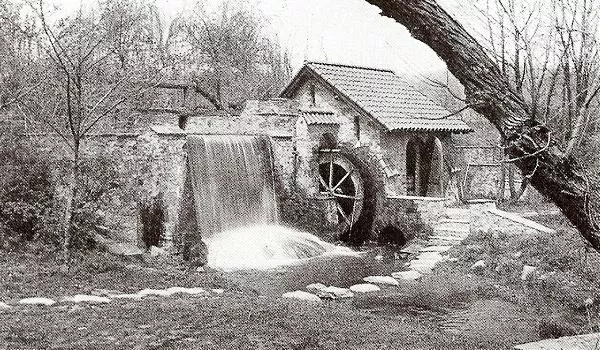
The iconic waterwheel at Eastern University
Public domain photo, circa 1913. Source
Aside from a chance comment by the admissions counsellor, there would have been nothing blogworthy about our college visit to Eastern University the other day. The day began in the admissions office, we toured the campus and had lunch in the campus cafeteria with a student tour-guide (Thanks, Collin!), then monitored a musicianship class and returned to the admissions office. Of course, all of that was interesting to a prospective student and his father, but nothing that would qualify for a blog post.
And before I go on, I'll veer a bit off topic and just note that it is a testament to his music instructors and his own hard work that @cmp2020 - a high school junior - sat through a third semester college level musicianship course, midway through the semester, and was easily keeping up with the lecture and the college students in attendance. Unlike his father, who didn't understand a word that was being said. ; -)
Anyway, back to the topic, while we were discussing the school's music program, Ben - the admissions counselor happened to mention that the school's music program was launched when they discovered one of Mozart's manuscripts in a safe. The interesting thing was, however, that I had already read about a manuscript discovery at the school in the early 2000s, and that manuscript was not Mozart, but Beethoven. So, I let the subject drop, but chalked it up to confusion by a non-musician, and assumed that Ben meant Beethoven when he said Mozart.
Today, however, I asked the Internet about it, and I found out that my assumption was incorrect. I was correct that Beethoven's Grosse Fugue manuscript had been discovered at the university in 2005, but what came as a surprise was that Ben's report of a Mozart discovery was also correct.
In 1990, the school had discovered manuscripts of Mozart's Fantasia in C Minor and his Sonata in C Minor.
According to the Christian Post, along with Mozart, the 1990 discovery also included works by Haydn, Meyerbeer and Spohr. The 1990 manuscripts sold for roughly $1.576 million, and the Beethoven manuscript sold for about $1.72 million, and the money was apparently used to fund scholarships and pay down debts.
Youth is wasted on the young, they say. The reason we chose Eastern University for @cmp2020's first college visit is because it's where I got my bachelor's degree. When I was a freshman and sophomore there, my dorm was called, "Doane Hall", and I had no idea where the name came from and no interest in learning about its history. However, in reading about these lost manuscripts, the name "William H. Doane" caught my attention as the person who previously owned all of these manuscripts, so finally it occurred to me to wonder who he was. It turns out that he was an Ohio industrialist, philanthropist, musician, and hymn writer, with more than 2,000 hymns to his credit.
So, I thought a post with some youtube videos might be in order to tie together these obscure historical links.
First up, here is one of the hymns I found when I searched for Doane's name. It was performed in 2012 by the Royal Albert Hall audience and stage choirs. This is a hymn which I have known for basically as long as I can remember, but I had never paid attention to the composer's name before:
https://youtu.be/-15v9iworAU
And here is Beethoven's Grosse Fuge, in a 2016 performance by the Australian Chamber Orchestra & Richard Tognetti. According to the NY Times, this was written in the last years of Beethoven's life, after his hearing had failed. He was inspired by Bach to use the fugue structure, and the manuscript contains powerful indications that he had his own legacy frequently in mind while he was creating it.
https://youtu.be/96bgojFa0KM
And finally, the two pieces by Mozart:
Sonata in C Minor
This was performed in 2015 by Micah McLaurin, a student from Philadelphia's world-renowned Curtis Institute. According to the description, the piece is closely linked to Beethoven's Pathetique Sonata. Beethoven's slow movement quoted, nearly verbatim, from Mozart's slow movement.
https://youtu.be/HfptgKV1qI4
Fantasia in C Minor
Here is Daniel Barenboim playing the Fantasia in C Minor. According to the Deseret News, these two Mozart pieces were written in 1784 and 1785, and are normally performed together.
https://youtu.be/COWVz007sHE
It was an interesting college visit, and I expect it will be the first of several, but as we continue the selection process I will be surprised if many of the schools that we visit on this side of the Atlantic can lay claim to one-time possession of original manuscripts by Beethoven, Mozart, and Haydn. For me, it was certainly an unexpected education into some surprising historical connections.
I have enjoyed listening to all of these musical performances while composing and proofreading this post. I hope you do too.
First published on the Steem blockchain by @remlaps on March 18, 2019. View the original post.


No comments:
Post a Comment